For those who just want to get some good information about how to plant a butterfly garden, click here
In honor of Earth Week, I wanted to write a post about gardening, specifically butterfly gardening. A big part of gardening is art and attracting beautiful creatures into your landscape. Attracting butterflies is frequently a gardening goal: googling "butterfly garden" returns 8,460,000 results, "attracting butterflies" returns 4,080,000 results, and "saving butterflies" returns 7,670,000 results. For those who use pinterest, typing in "butterfly garden" returns all sorts of tutorial guides about which flowers to plant for which butterflies, ads for buying butterfly houses, and all sorts of butterfly feeders.
Much of the advice I come across in these articles suggest the use of non-native species to support butterfly populations. In the recent Cheerio's campaign to bring back the bees by giving out free wildflower seed mixes (1), the company supplying the seeds had to defend their mix given that the species were non-native (although not listed as invasive) to many of the areas the mix would be going to (2). It's why I don't trust "wildflower" mixes at the big box stores because they can (A) contain invasive species that threaten the remaining native wild populations, (B) be non-native and thus alter the surrounding community with potentially negative consequences to species that rely on specific plants for food, (C) not do well in my particular climate because those species aren't adapted to my area.
It's fairly obvious that people want to take action to make their lived environments friendlier to butterflies, but it's hard to figure out the best course of action. Attention has been brought to some threatened species like monarch butterflies and milkweed populations (3,4), but there are many other species of butterflies and skippers that deserve attention. In the remainder of this article, I want to take a closer look at the butterfly species that are threatened or endangered in Iowa, what they feed upon, and what action Iowan (and other Midwestern) gardeners can do to help support these struggling populations.
The Iowa DNR (Department of Natural Resources) lists two species as endangered: The Dakota Skipper (Hesperia dacotae) and the Ringlet (Coenonympha tullia). However since that report published in 2009, the Powesheik Skipperling (Oarisma powesheik) has been added to the list. In addition to those, the Iowa DNR lists 4 species as threatened and 25 species as animals of special concern (see below for list of species names) (5,6). The U.S. Fish and Wildlife Service, which administrates and enforces the Endangered Species Act (which in turn created the Endangered Species List), lists the Dakota Skipper as threatened and the Powesheik Skipperling as endangered as of 2016 (7, 10).
Both the Dakota Skipper and the Powesheik Skipperling rely on high quality prairie to sustain their populations. Given that most of the prairie has been converted by intensive row-crop agriculture and urban expansion, these two species have been hardest hit by habitat loss. Increased pressure from changing fire regimes, droughts, increased wide-spread pesticide use and climate change has further harmed these species (8). As of 2014, the Dakota skipper was found at 35% of its historic sites while the Powesheik Skipperling was found at a mere 5% of its historic sites (8).
The Dakota Skipper feeds on grasses as a larva and nectar as an adult, so including little bluestem and nectar rich flowers is helpful (9). The best thing to do with fields where the Dakota Skipper occurs is to avoid plowing, heavy grazing or mowing in the summer, and herbicide use on nectar bearing plants (9). This should help provide the correct food sources as well as leaving the soil undisturbed, given that the larvae spend time at or near the soil surface (9). Because these skippers don't travel great distances between patches of suitable habitat (<1km) (9), creating corridors of native plants connecting areas in which these skippers currently live may increase their population and help prevent inbreeding.
The Powesheik Skipperling is in more dire straits. Considered critically imperiled, this species declined severely and swiftly in the 2000s, the cause of which is still unknown (10, 11). Individuals have not been seen in Iowa since 2008 (10). These skippers may be more sensitive to fire and prefer fen, bog and wet prairie habitats, often only found in virgin prairie. Like the Dakota Skipper, the larvae are herbivorous and the adults feed on nectar (11). However, the Powesheik Skipperling is threatened by an invasive plant, Frangula alnus or glossy buckthorn, which eliminates the skipper's food source of grasses, sedges, and rushes (11).
It's unlikely that you own land that has prairie remnants that support these populations already, but if you do, FANTASTIC! Keep those remnants alive! Reach out to your local office of U.S. FWS, DNR, or Nature Conservancy to keep up to date on the latest research on managing these endangered habitats.
For those of us who don't live with a prairie remnant, consider volunteering with the Iowa Natural Heritage Foundation to help maintain these natural areas and get a better understanding of the prairie ecosystem and community. Another possibility is the inclusion of native plants within your landscape. There are so many native plants and a growing list of native plant providers that you're sure to find something you'll love. Prairie plants can be unruly, but with careful planning, they can also be rewarding in supporting native insects (like butterflies and bees) and requiring less work and resources in the long term given their evolution with the Midwest's particular climate. Consider setting aside a corner to taller prairie grasses that can provide needed habitat and food for butterflies. But most importantly, stay informed about the local flora and fauna with whom we share this landscape and spread that information with others.
Other butterfly species listed by the Iowa DNR (5,6)
Threatened species
1. Byssus Skipper (Problema byssus)
2. Mulberry Wing (Poanes massasoit)
3. Silvery Blue (Glaucopsyche lygdamus)
4. Baltimore Checkerspot (Euphydryas phaeton)
Animals of Special Concern
1. Dreamy Duskywing (Erynnis icelus)
2. Sleepy Duskywing (Erynnis brizo)
3. Columbine Duskywing (Erynnis lucilius)
4. Wild Indigo Duskywing (Erynnis baptisiae)
5. Ottoe Skipper (Hesperia ottoe)
6. Leonardus Skipper (Hesperia leonardus)
7. Pawnee Skipper (Hesperia leonardus pawnee)
8. Beardgrass Skipper (Atrytone arogos)
9. Zabulon Skipper (Poanes zabulon)
10. Broad-winged Skipper (Poanes viator)
11. Sedge Skipper (Euphyes dion)
12. Two-spotted Skipper (Euphyes bimacula)
13. Dusted Skipper (Atrytonopsis hianna)
14. Salt-and-pepper Skipper (Amblyscirtes hegon)
15. Pipevine Swallowtail (Battus philenor)
16. Zebra Swallowtail (Eurytides marcellus)
17. Olympia White (Euchloe olympia)
18. Purplish Copper (Lycaena helloides)
19. Acadian Hairstreak (Satyrium acadicum)
20. Edward’s Hairstreak (Satyrium edwardsii)
21. Hickory Hairstreak (Satyrium caryaevorum)
22. Striped Hairstreak (Satyrium liparops)
23. Swamp Metalmark (Calephelis mutica)
24. Regal Fritillary (Speyeria idalia)
25. Baltimore Checkerspot (Euphydryas phaeton ozarkae)
References:
1: http://www.cheerios.com/bringbackthebees
2: http://www.cbc.ca/news/canada/prince-edward-island/pei-veseys-seeds-wildflower-mix-questions-gmo-invasive-species-1.4032641
3: http://monarchwatch.org/
4: http://monarchwatch.org/blog/2017/02/11/monarch-population-status-30/
5: http://www.iowadnr.gov/Conservation/Threatened-Endangered
6: https://www.legis.iowa.gov/docs/ACO/rule/571.77.2.pdf
7: https://ecos.fws.gov/ecp0/reports/species-listed-by-state-report?state=IA&status=listed
8: http://www.biologicaldiversity.org/news/press_releases/2014/prairie-butterflies-10-23-2014.html
9:http://explorer.natureserve.org/servlet/NatureServe?searchName=Hesperia+dacotae
10: https://www.fws.gov/Midwest//Endangered/insects/dask/ButterfliesFinalListQAs22Oct2014.html
11: http://explorer.natureserve.org/servlet/NatureServe?searchName=Oarisma+poweshiek
Additional resources:
U.S. FWS profile on the Dakota Skipper: https://ecos.fws.gov/ecp0/profile/speciesProfile?spcode=I011
U.S. FWS profile on the Powesheik Skipperling: https://ecos.fws.gov/ecp0/profile/speciesProfile?spcode=I0W1
 |
| From my prairie garden in August 2015, 4 monarch butterflies feast on Liatris sp. (Blazing Star) nectar |
In honor of Earth Week, I wanted to write a post about gardening, specifically butterfly gardening. A big part of gardening is art and attracting beautiful creatures into your landscape. Attracting butterflies is frequently a gardening goal: googling "butterfly garden" returns 8,460,000 results, "attracting butterflies" returns 4,080,000 results, and "saving butterflies" returns 7,670,000 results. For those who use pinterest, typing in "butterfly garden" returns all sorts of tutorial guides about which flowers to plant for which butterflies, ads for buying butterfly houses, and all sorts of butterfly feeders.
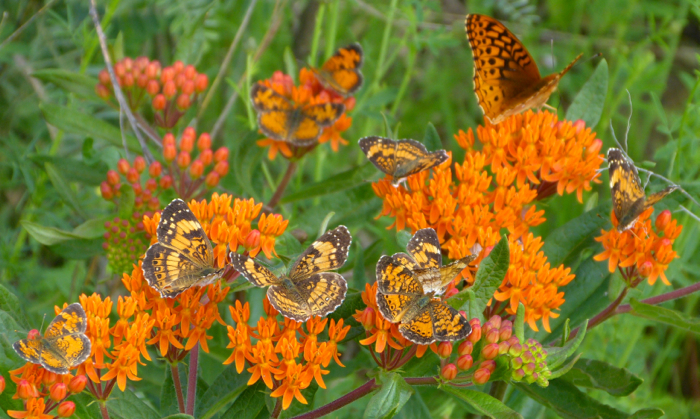 |
| Milkweed, not just for Monarch butterflies! |
But I'm concerned.
Much of the advice I come across in these articles suggest the use of non-native species to support butterfly populations. In the recent Cheerio's campaign to bring back the bees by giving out free wildflower seed mixes (1), the company supplying the seeds had to defend their mix given that the species were non-native (although not listed as invasive) to many of the areas the mix would be going to (2). It's why I don't trust "wildflower" mixes at the big box stores because they can (A) contain invasive species that threaten the remaining native wild populations, (B) be non-native and thus alter the surrounding community with potentially negative consequences to species that rely on specific plants for food, (C) not do well in my particular climate because those species aren't adapted to my area.
 |
| Butterfly feeding on Echinacea sp. (Purple Coneflower) |
It's fairly obvious that people want to take action to make their lived environments friendlier to butterflies, but it's hard to figure out the best course of action. Attention has been brought to some threatened species like monarch butterflies and milkweed populations (3,4), but there are many other species of butterflies and skippers that deserve attention. In the remainder of this article, I want to take a closer look at the butterfly species that are threatened or endangered in Iowa, what they feed upon, and what action Iowan (and other Midwestern) gardeners can do to help support these struggling populations.
The Iowa DNR (Department of Natural Resources) lists two species as endangered: The Dakota Skipper (Hesperia dacotae) and the Ringlet (Coenonympha tullia). However since that report published in 2009, the Powesheik Skipperling (Oarisma powesheik) has been added to the list. In addition to those, the Iowa DNR lists 4 species as threatened and 25 species as animals of special concern (see below for list of species names) (5,6). The U.S. Fish and Wildlife Service, which administrates and enforces the Endangered Species Act (which in turn created the Endangered Species List), lists the Dakota Skipper as threatened and the Powesheik Skipperling as endangered as of 2016 (7, 10).
Both the Dakota Skipper and the Powesheik Skipperling rely on high quality prairie to sustain their populations. Given that most of the prairie has been converted by intensive row-crop agriculture and urban expansion, these two species have been hardest hit by habitat loss. Increased pressure from changing fire regimes, droughts, increased wide-spread pesticide use and climate change has further harmed these species (8). As of 2014, the Dakota skipper was found at 35% of its historic sites while the Powesheik Skipperling was found at a mere 5% of its historic sites (8).
 |
| From the Minnesota Zoo, a female Dakota Skipper |
The Dakota Skipper feeds on grasses as a larva and nectar as an adult, so including little bluestem and nectar rich flowers is helpful (9). The best thing to do with fields where the Dakota Skipper occurs is to avoid plowing, heavy grazing or mowing in the summer, and herbicide use on nectar bearing plants (9). This should help provide the correct food sources as well as leaving the soil undisturbed, given that the larvae spend time at or near the soil surface (9). Because these skippers don't travel great distances between patches of suitable habitat (<1km) (9), creating corridors of native plants connecting areas in which these skippers currently live may increase their population and help prevent inbreeding.
 |
| Powesheik Skipperling feeding on nectar (Rudbeckia sp?) |
The Powesheik Skipperling is in more dire straits. Considered critically imperiled, this species declined severely and swiftly in the 2000s, the cause of which is still unknown (10, 11). Individuals have not been seen in Iowa since 2008 (10). These skippers may be more sensitive to fire and prefer fen, bog and wet prairie habitats, often only found in virgin prairie. Like the Dakota Skipper, the larvae are herbivorous and the adults feed on nectar (11). However, the Powesheik Skipperling is threatened by an invasive plant, Frangula alnus or glossy buckthorn, which eliminates the skipper's food source of grasses, sedges, and rushes (11).
So what can you do?
It's unlikely that you own land that has prairie remnants that support these populations already, but if you do, FANTASTIC! Keep those remnants alive! Reach out to your local office of U.S. FWS, DNR, or Nature Conservancy to keep up to date on the latest research on managing these endangered habitats.
For those of us who don't live with a prairie remnant, consider volunteering with the Iowa Natural Heritage Foundation to help maintain these natural areas and get a better understanding of the prairie ecosystem and community. Another possibility is the inclusion of native plants within your landscape. There are so many native plants and a growing list of native plant providers that you're sure to find something you'll love. Prairie plants can be unruly, but with careful planning, they can also be rewarding in supporting native insects (like butterflies and bees) and requiring less work and resources in the long term given their evolution with the Midwest's particular climate. Consider setting aside a corner to taller prairie grasses that can provide needed habitat and food for butterflies. But most importantly, stay informed about the local flora and fauna with whom we share this landscape and spread that information with others.
 |
| Prairie isn't just grass! |
Other butterfly species listed by the Iowa DNR (5,6)
Threatened species
1. Byssus Skipper (Problema byssus)
2. Mulberry Wing (Poanes massasoit)
3. Silvery Blue (Glaucopsyche lygdamus)
4. Baltimore Checkerspot (Euphydryas phaeton)
Animals of Special Concern
1. Dreamy Duskywing (Erynnis icelus)
2. Sleepy Duskywing (Erynnis brizo)
3. Columbine Duskywing (Erynnis lucilius)
4. Wild Indigo Duskywing (Erynnis baptisiae)
5. Ottoe Skipper (Hesperia ottoe)
6. Leonardus Skipper (Hesperia leonardus)
7. Pawnee Skipper (Hesperia leonardus pawnee)
8. Beardgrass Skipper (Atrytone arogos)
9. Zabulon Skipper (Poanes zabulon)
10. Broad-winged Skipper (Poanes viator)
11. Sedge Skipper (Euphyes dion)
12. Two-spotted Skipper (Euphyes bimacula)
13. Dusted Skipper (Atrytonopsis hianna)
14. Salt-and-pepper Skipper (Amblyscirtes hegon)
15. Pipevine Swallowtail (Battus philenor)
16. Zebra Swallowtail (Eurytides marcellus)
17. Olympia White (Euchloe olympia)
18. Purplish Copper (Lycaena helloides)
19. Acadian Hairstreak (Satyrium acadicum)
20. Edward’s Hairstreak (Satyrium edwardsii)
21. Hickory Hairstreak (Satyrium caryaevorum)
22. Striped Hairstreak (Satyrium liparops)
23. Swamp Metalmark (Calephelis mutica)
24. Regal Fritillary (Speyeria idalia)
25. Baltimore Checkerspot (Euphydryas phaeton ozarkae)
References:
1: http://www.cheerios.com/bringbackthebees
2: http://www.cbc.ca/news/canada/prince-edward-island/pei-veseys-seeds-wildflower-mix-questions-gmo-invasive-species-1.4032641
3: http://monarchwatch.org/
4: http://monarchwatch.org/blog/2017/02/11/monarch-population-status-30/
5: http://www.iowadnr.gov/Conservation/Threatened-Endangered
6: https://www.legis.iowa.gov/docs/ACO/rule/571.77.2.pdf
7: https://ecos.fws.gov/ecp0/reports/species-listed-by-state-report?state=IA&status=listed
8: http://www.biologicaldiversity.org/news/press_releases/2014/prairie-butterflies-10-23-2014.html
9:http://explorer.natureserve.org/servlet/NatureServe?searchName=Hesperia+dacotae
10: https://www.fws.gov/Midwest//Endangered/insects/dask/ButterfliesFinalListQAs22Oct2014.html
11: http://explorer.natureserve.org/servlet/NatureServe?searchName=Oarisma+poweshiek
Additional resources:
U.S. FWS profile on the Dakota Skipper: https://ecos.fws.gov/ecp0/profile/speciesProfile?spcode=I011
U.S. FWS profile on the Powesheik Skipperling: https://ecos.fws.gov/ecp0/profile/speciesProfile?spcode=I0W1


This is so articulate and informative, Sam! What a lovely way to bring attention to an issue I hadn't thought of before (ie. butterfly gardens, not native vs. invasive species). Can't wait to see what else is in store!
ReplyDelete