Thursday, April 27, 2017

Timelapse of a Flowering Phalaenopsis Hybrid Orchid

This is for all those who've said, "but plants are so boring! They don't do anything!"


When I noticed Suzel, my pet Phalaenopsis hybrid orchid, was starting to bud I was so excited for the blossoms. It also presented me with an opportunity to share some of the remarkable and dramatic changes of form that plants can undergo during their life cycles (this one being a reproductive stage). Orchids in particular are unique as their blooms are quite specialized and extremely diverse in form and functions
  
The Orchidaceae is the largest family of flowering plants on Earth, encompassing 8% of all vascular plants (1). The family contains 25,000 species (1,2). There are so many incredible topics in relation to orchids such as mycorrhizal fungi symbiosis (or potentially parasitism! We still don't know which one it is or if it is determined on a species by species basis!), pollinator specialization, reproduction strategies, epiphyte coping strategies for difficult environments, folklore, traditional medicine and spices, bioprospecting, propagation in captivity, ecosystem restoration and protection... the list goes on. 

While I could continue to talk about all these glorious features of orchids, I simply want to foreshadow another post I'm working on about native bee species while also sharing the joy of finally getting the right conditions for this orchid to bloom. As you watch, consider a few things: 

1. These flowers are complex structures to serve the simple purpose of attracting pollinators and disseminating/receiving pollen from other plants of the same species. This is in part to increase specialized pollination relationships with a particular species of pollinator to reduce the chance of getting incompatible pollen from a flower of a different species. But it also means that these flowers take a lot of resources and energy to make and then maintain!

2. These flowers are slow to develop. While the video doesn't show the months it took the plant to grow the flower stalk, nor the incredible amount of resources the plant had to stockpile and then use to build these structures and maintain them, the video DOES show the entire floral display taking a full 10 weeks to open fully. Compare and contrast to other species of flowers. How might this be advantageous in terms of pollination? How might this be disadvantageous in terms of pollination? Essentially, what are the trade offs?

3. Observe the complexity of the flower form and consider what parameters a pollinator might have to meet to successfully pollinate said flower? Especially given that most individuals of a species in the wild tend not to clump together, requiring pollinators to seek out these individuals over various ranges. 

4. Consider the environmental variables that help the plant decide when to devote its resources to flowering: temperature, light, water. Given that the climate is changing, these environmental factors may become unstable relative to historic norms. Yet, the individual plants will still have mechanisms regulating flowering processes based on those environmental factors, and will respond to those changing environmental factors and not necessarily in the same way its pollinator species will or won't respond to those same changes. 

I hope you enjoy watching the orchid's transformation from bud to bloom and appreciate the immense work such development takes. I also hope it gets you thinking about the intimate ways in which pollinators and plants interact and depend on each other for survival, and how a changing environment may impact those dynamics. 

References:

(1)  Freudenstein, John V.; van den Berg, Cássio; Goldman, Douglas H.; Kores, Paul J.; Molvray, Mia; Chase, Mark W. 2003. An expanded plastid DNA phylogeny of Orchidaceae and analysis of jackknife branch support strategy. American Journal of Botany vol 91 (1): 149-157.
(2)  Albert, Victor A. And Carretero-Paulet, Lorenzo. 2015. A Genome to Unveil the Mysteries of Orchids. Nature Genetics 47(1): 3-4.
 

Sunday, April 23, 2017

Endangered and Threatened Prairie Butterflies (and what you can do to help them)

For those who just want to get some good information about how to plant a butterfly garden, click here
From my prairie garden in August 2015, 4 monarch butterflies feast on Liatris sp. (Blazing Star) nectar

In honor of Earth Week, I wanted to write a post about gardening, specifically butterfly gardening. A big part of gardening is art and attracting beautiful creatures into your landscape. Attracting butterflies is frequently a gardening goal: googling "butterfly garden" returns 8,460,000 results, "attracting butterflies" returns 4,080,000 results, and "saving butterflies" returns 7,670,000 results. For those who use pinterest, typing in "butterfly garden" returns all sorts of tutorial guides about which flowers to plant for which butterflies, ads for buying butterfly houses, and all sorts of butterfly feeders.
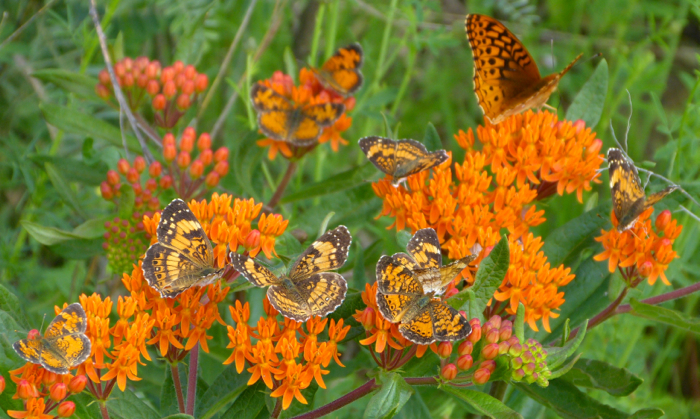
butterflies on butterflyweed 6-28-14
Milkweed, not just for Monarch butterflies!

But I'm concerned.

Much of the advice I come across in these articles suggest the use of non-native species to support butterfly populations. In the recent Cheerio's campaign to bring back the bees by giving out free wildflower seed mixes (1), the company supplying the seeds had to defend their mix given that the species were non-native (although not listed as invasive) to many of the areas the mix would be going to (2). It's why I don't trust "wildflower" mixes at the big box stores because they can (A) contain invasive species that threaten the remaining native wild populations, (B) be non-native and thus alter the surrounding community with potentially negative consequences to species that rely on specific plants for food, (C) not do well in my particular climate because those species aren't adapted to my area.
Decorah Community Prairie & Butterfly Garden - Decorah, Iowa
Butterfly feeding on Echinacea sp. (Purple Coneflower)

It's fairly obvious that people want to take action to make their lived environments friendlier to butterflies, but it's hard to figure out the best course of action. Attention has been brought to some threatened species like monarch butterflies and milkweed populations (3,4), but there are many other species of butterflies and skippers that deserve attention. In the remainder of this article, I want to take a closer look at the butterfly species that are  threatened or endangered in Iowa, what they feed upon, and what action Iowan (and other Midwestern) gardeners can do to help support these struggling populations.

The Iowa DNR (Department of Natural Resources) lists two species as endangered: The Dakota Skipper (Hesperia dacotae) and the Ringlet (Coenonympha tullia). However since that report published in 2009, the Powesheik Skipperling (Oarisma powesheik) has been added to the list. In addition to those, the Iowa DNR lists 4 species as threatened and 25 species as animals of special concern (see below for list of species names) (5,6). The U.S. Fish and Wildlife Service, which administrates and enforces the Endangered Species Act (which in turn created the Endangered Species List), lists the Dakota Skipper as threatened and the Powesheik Skipperling as endangered as of 2016 (7, 10).

Both the Dakota Skipper and the Powesheik Skipperling rely on high quality prairie to sustain their populations. Given that most of the prairie has been converted by intensive row-crop agriculture and urban expansion, these two species have been hardest hit by habitat loss. Increased pressure from changing fire regimes, droughts, increased wide-spread pesticide use and climate change has further harmed these species (8). As of 2014, the Dakota skipper was found at 35% of its historic sites while the Powesheik Skipperling was found at a mere 5% of its historic sites (8).
From the Minnesota Zoo, a female Dakota Skipper

 The Dakota Skipper feeds on grasses as a larva and nectar as an adult, so including little bluestem and nectar rich flowers is helpful (9). The best thing to do with fields where the Dakota Skipper occurs is to avoid plowing, heavy grazing or mowing in the summer, and herbicide use on nectar bearing plants (9). This should help provide the correct food sources as well as leaving the soil undisturbed, given that the larvae spend time at or near the soil surface (9). Because these skippers don't travel great distances between patches of suitable habitat (<1km) (9), creating corridors of native plants connecting areas in which these skippers currently live may increase their population and help prevent inbreeding. 
Poweshiek Skipperling — wisconsinbutterflies.org
Powesheik Skipperling feeding on nectar (Rudbeckia sp?)

 The Powesheik Skipperling is in more dire straits. Considered critically imperiled, this species declined severely and swiftly in the 2000s, the cause of which is still unknown (10, 11). Individuals have not been seen in Iowa since 2008 (10). These skippers may be more sensitive to fire and prefer fen, bog and wet prairie habitats, often only found in virgin prairie. Like the Dakota Skipper, the larvae are herbivorous and the adults feed on nectar (11). However, the Powesheik Skipperling is threatened by an invasive plant, Frangula alnus or glossy buckthorn, which eliminates the skipper's food source of grasses, sedges, and rushes (11).

So what can you do?

It's unlikely that you own land that has prairie remnants that support these populations already, but if you do, FANTASTIC! Keep those remnants alive! Reach out to your local office of U.S. FWS, DNR, or Nature Conservancy to keep up to date on the latest research on managing these endangered habitats.

For those of us who don't live with a prairie remnant, consider volunteering with the Iowa Natural Heritage Foundation to help maintain these natural areas and get a better understanding of the prairie ecosystem and community. Another possibility is the inclusion of native plants within your landscape. There are so many native plants and a growing list of native plant providers that you're sure to find something you'll love. Prairie plants can be unruly, but with careful planning, they can also be rewarding in supporting native insects (like butterflies and bees) and requiring less work and resources in the long term given their evolution with the Midwest's particular climate. Consider setting aside a corner to taller prairie grasses that can provide needed habitat and food for butterflies. But most importantly, stay informed about the local flora and fauna with whom we share this landscape and spread that information with others.
Prairie Moon Nursery :: Plants :: Potted Plants :: Potted Garden Kits ...
Prairie isn't just grass!

Other butterfly species listed by the Iowa DNR (5,6)
Threatened species
1. Byssus Skipper (Problema byssus)
2. Mulberry Wing (Poanes massasoit)
3. Silvery Blue (Glaucopsyche lygdamus)
4. Baltimore Checkerspot (Euphydryas phaeton)

Animals of Special Concern 
1. Dreamy Duskywing (Erynnis icelus)
2. Sleepy Duskywing (Erynnis brizo)
3. Columbine Duskywing (Erynnis lucilius)
4. Wild Indigo Duskywing (Erynnis baptisiae)
5. Ottoe Skipper (Hesperia ottoe)
6. Leonardus Skipper (Hesperia leonardus)
7. Pawnee Skipper (Hesperia leonardus pawnee)
8. Beardgrass Skipper (Atrytone arogos)
9. Zabulon Skipper (Poanes zabulon)
10. Broad-winged Skipper (Poanes viator)
11. Sedge Skipper (Euphyes dion)
12. Two-spotted Skipper (Euphyes bimacula)
13. Dusted Skipper (Atrytonopsis hianna)
14. Salt-and-pepper Skipper (Amblyscirtes hegon)
15. Pipevine Swallowtail (Battus philenor)
16. Zebra Swallowtail (Eurytides marcellus)
17. Olympia White (Euchloe olympia)
18. Purplish Copper (Lycaena helloides)
19. Acadian Hairstreak (Satyrium acadicum)
20. Edward’s Hairstreak (Satyrium edwardsii)
21. Hickory Hairstreak (Satyrium caryaevorum)
22. Striped Hairstreak (Satyrium liparops)
23. Swamp Metalmark (Calephelis mutica)
24. Regal Fritillary (Speyeria idalia)
25. Baltimore Checkerspot (Euphydryas phaeton ozarkae)


References:
1: http://www.cheerios.com/bringbackthebees
2: http://www.cbc.ca/news/canada/prince-edward-island/pei-veseys-seeds-wildflower-mix-questions-gmo-invasive-species-1.4032641
3: http://monarchwatch.org/
4: http://monarchwatch.org/blog/2017/02/11/monarch-population-status-30/
5: http://www.iowadnr.gov/Conservation/Threatened-Endangered
6: https://www.legis.iowa.gov/docs/ACO/rule/571.77.2.pdf
7: https://ecos.fws.gov/ecp0/reports/species-listed-by-state-report?state=IA&status=listed
8: http://www.biologicaldiversity.org/news/press_releases/2014/prairie-butterflies-10-23-2014.html
9:http://explorer.natureserve.org/servlet/NatureServe?searchName=Hesperia+dacotae
10: https://www.fws.gov/Midwest//Endangered/insects/dask/ButterfliesFinalListQAs22Oct2014.html
11: http://explorer.natureserve.org/servlet/NatureServe?searchName=Oarisma+poweshiek

Additional resources:
U.S. FWS profile on the Dakota Skipper: https://ecos.fws.gov/ecp0/profile/speciesProfile?spcode=I011
 U.S. FWS profile on the Powesheik Skipperling: https://ecos.fws.gov/ecp0/profile/speciesProfile?spcode=I0W1


Monday, April 3, 2017

Venus Flytrap Eating a Housefly

Carnivorous plants can be gruesome. As a keeper of one venus flytrap, pet name Lazarus, I'm often asked about the macabre task of feeding her. Ideally, she catches her own food. But sometimes I supplement her diet with rehydrated freeze dried blood worms should the need arise.

Recently, she caught a housefly, the first sign of her return from winter dormancy this spring*! While I didn't catch the trap activating on video, I have compiled a video documenting the digestion process over the course of three weeks. View below!


You may have noticed two things. Some pictures have a purplish cast to them. No, you didn't miss a solar event in which sunlight turned purple. Due to the shorter winter daylight hours and the cold outdoor temperatures, my collection of plants wouldn't be able to get their needed sunshine to thrive based off what can filter in through the window. Instead, I have invested in an LED hydroponic light that emits red and blue light, the two major wavelengths that most plants need to survive and regulate their inner hormonal cycles. The grow light is what is responsible for the disorienting color change.

The ending also took a turn that I wasn't expecting. I had hoped to show the trap reopening, revealing the remaining exoskeleton of the fly morbidly stuck to the walls of the trap. But that's not what happened. Instead, the trap died.

This can happen for a number of reasons. One common reason with hand fed plants is that the amount of food was too much for the leaf to digest, so the leaf gluts itself but then begins to rot. However, I think this leaf died of a different cause, age. The leaf had been growth from the previous season and so was closing on a year in age. Because the activation of the trap takes such enormous amounts of energy, it can be really hard on the plant to repair and otherwise maintain an old trap. In those cases, the trap digests the prey as usual, but when finished, the nutrients stored in the trap are broken down and reallocated to other parts of the plant. This is similar to when trees reallocate nutrients from leaves to their roots in the fall, causing the leaves to die and fall off. If you reexamine the video, you'll find a number of new traps exploding on the rush of nutrients from out of the center of the rosette as the old trap withers away.

Sound off in the comments if you have any other questions about the wonderful and terrifying Dionaea muscipula!

*Fun fact: Venus flytraps are not from the tropics! They are considered temperate plants and are endemic to the bog swamps of the Carolinas, U.S.A. Because of this, they must go through a winter dormancy period to be healthy. They are also unique in that there is only one species in the entire genus and they are very distantly related from other genera, making their phylogeny quite distinct.

References
Since most of this information has accumulated over the years as I've read up on the care of carnivorous plants, it's hard to attribute any one piece of information to a source. I can recommend "Savage Garden" by Peter D'Amato (2013) to anyone looking for a detailed primer on the subject.